1. Interpretation and Definitions
1.1 Company Main Street 1723 (Pty) Ltd, with registration number
2019/300711/07, both the Kazang and Card Connect
business divisions;
1.2 Chief Executive Officer the person who is responsible for the overall
management and control of the Company’s business
operations;
1.3 OHS Occupational Health and Safety;
1.4 OHS Act Occupational Health and Safety Act 85 of 1993, as
amended from time to time;
1.5 OHS Policy this written policy concerning the protection of the
health and safety of the Company’s employees at the
workplace;
1.6 workplace means any premises or place where an employee
performs work.
2. Purpose and Overview
2.1. In terms of section 7 of the OHS Act, the Company is required to prepare a written
policy concerning the protection of the health and safety of the Company’s
employees at the workplace.
2.2. The Company is committed to providing and maintaining, as far as reasonably
practicable, a working environment that is safe and without risk to the health of its
employees. In accordance with the requirements of the OHS Act, the responsibility
for health and safety at the workplace is a shared responsibility between the
Company and its employees. This OHS Policy aims to establish the Company’s
standards and procedures concerning health and safety at the workplace.
3. Description of Organisation
3.1. Kazang business division
3.1.1. The Kazang business division provides point of sale devices to its clients
which enable its clients to sell value added services to its customers, such as
prepaid airtime, electricity, prepaid vouchers and micro-payment services.
3.2. Card Connect business division
3.2.1. The Card Connect business division provides point of sale devices to its
clients which enable its clients to accept card payments from its customers.
4. Arrangements for Carrying Out and Reviewing the Policy
4.1. The carrying out of the duties described in more detail in this OHS Policy, will be
done by the following persons:
4.1.1. Overall accountability for compliance by the OHS Act borne by Chief
Executive Officer, unless an Assistant to the Chief Executive Officer is
appointed in terms of section 16(2) of the OHS Act;
4.1.2. Implementation and carrying out of the general duties prescribed in section
8(2) of the OHS Act by the OHS Administrator;
4.1.3. Compliance audit by the OHS Compliance Officer;
4.1.4. Incident investigation and reporting duties by the Incident Investigator;
4.1.5. Duties assigned to Health and Safety Representative(s);
4.1.6. Duties assigned to Health and Safety Committee;
4.1.7. Procurement of first aid supplies, equipment and provision of necessary
treatment by First Aider(s).
4.2. The OHS Policy will be reviewed on an annual basis by the OHS Compliance
Officer. The review will include a compliance audit, gap analysis and
recommendations required for improvement to compliance. If required, the OHS
Compliance Officer will make the necessary amendments to the appointments and
the OHS Policy for approval by the Chief Executive Officer.
5. Responsibility of the Chief Executive Officer and Delegated Appointments
5.1. In terms of section 16(1) of the OHS Act, the Chief Executive Officer is responsible
for ensuring as far as is reasonably practicable that the duties prescribed in the
OHS Act are complied with.
5.2. The Chief Executive Officer of the Company may, in terms of section 16(2) of the
OHS Act, assign the duties of the Company to employees within the company,
which shall include but not be limited to:
5.2.1. Section 16(2) appointment of the ‘Assistant to the Chief Executive Officer’
which includes responsibilities of overall management of the Company’s
duties in terms of the OHS Act, if necessary;
5.2.2. Section 8(2) appointment of ‘OHS Administrator’, which shall include the
implementation and carrying out of the general duties prescribed in terms of
section 8(2) of the OHS Act and any such recommendations made by the
Health and Safety Committee;
5.2.3. Appointment of ‘OHS Compliance Officer’ which includes duties such as:
5.2.3.1. Compliance Audit duties, where the Company is obligated to ensure
that the members of the Health and Safety Committee have performed
their duties as prescribed in the OHS Act and this OHS Policy, which
shall be assigned to a member within the Legal Department;
5.2.3.2. Review of the OHS Policy on an annual basis;
5.2.3.3. This person shall be classified as a section 19(3) appointment to the
Occupational Health and Safety Committee.
5.2.4. Appointment of ‘Incident Investigator’, as required by the General
Administration Regulation 8(1) and section 24 of the OHS Act, which includes
reporting duties as prescribed in section 24 of the OHS Act, which shall be
assigned to a senior manager within the Human Resources Department;
5.2.5. Appointment of a ‘First Aider’ as required by the General Safety Regulations
3(1) and (4), which includes first aid duties, such as the procurement of first
aid supplies, equipment and provision of necessary treatment;
5.3. Any such delegation of duties by the Chief Executive Officer shall be done by way
of written delegation which shall be signed, dated and saved in the Company’s OHS
records.
6. Appointing the Health and Safety Representative
6.1. The Company will at all times have a designated Health and Safety Representative
appointed in writing for one-year terms.
6.2. Health and Safety Representatives shall be nominated by employees and
management. The employees nominated to the committee may not be managers or
directors of the company.
6.3. The Company may appoint two or more Health and Safety Representatives for
different sections of the workplace, as required, provided that the Company shall at
all times ensure that there is at least one Health and Safety Representative
appointed for each office and one for every 100 employees. Such appointments
must be signed, dated and saved in the Company’s OHS records, and where
applicable, be in line with such form as prescribed by the OHS Act.
6.4. The Company may only appoint a person as the Health and Safety Representative
who is a full-time permanent employee of the Company and is acquainted with
conditions and activities at the workplace or section thereof, as the case may be.
6.5. The Health and Safety Representative shall perform his/her duties during ordinary
working hours.
6.6. The names of the employees appointed as Health and Safety Representative(s)
must be communicated to all employees and displayed on the employees notice
boards (including electronic notice boards).
7. Functions of the Health and Safety Representative
7.1. The Health and Safety Representative shall in respect of the workplace or his/her
designated section of the workplace:
7.1.1. Review the effectiveness of the health and safety measures established in
terms of this OHS Policy and at the workplace.
7.1.2. Identify potential hazards and potential major incidents at the workplace.
7.1.3. In collaboration with the Company, examine the causes of incidents at the
workplace.
7.1.4. Make representations and/or recommendations to the Company on matters
arising from the above (1-3) as well as general matters affecting health and
safety of the employees at the workplace.
7.1.5. Inspect the workplace, including any article, substance, plant, machinery or
health and safety equipment (such as the fire extinguisher) at the workplace
considering the health and safety of the employees, which inspection shall
take place during the first month of each quarter (during January, April, July,
October).
7.1.6. Participate in consultations with inspectors and accompany inspectors on
inspections at the workplace.
7.1.7. Attend all Health and Safety Committee Meetings of which the Health and
Safety Representative shall be a member.
7.1.8. Attend the site of an incident at all reasonable times and attend inspections in
loco.
7.1.9. Attend any investigation or formal inquiry held under the OHS Act.
7.1.10. Inspect any document required to be kept by the Company in terms of the
OHS Act.
7.1.11. Be entitled to request, and upon the Company’s approval, be accompanied by
a technical adviser while conducting his/her inspection.
7.1.12. Participate in any internal health and safety compliance audit.
7.2. The Company shall provide such facilities, assistance and training as may be
required by the Health and Safety Representative. It will be the responsibility of the
Health and Safety Representative to present and make recommendations regarding
such requirement to the Company for the Company’s consideration.
8. Health and Safety Committee
8.1. The Company shall establish a Health and Safety Committee.
8.2. The members of the Health and Safety Committee shall be designated and
appointed by the Company in writing, but shall at all times include one or persons
with the following designations:
8.2.1. All appointed Health and Safety Representatives;
8.2.2. The appointed OHS Compliance Officer and/or a person within the Legal
Department;
8.2.3. The appointed Incident Investigator and/or a person within the Human
Recourse Department;
8.2.4. The appointed OHS Administrator;
8.2.5. The appointed Assistant to the Chief Executive Officer;
8.2.6. A person within the Executive Committee;
8.2.7. The appointed First Aider.
8.3. The Health and Safety Committee shall appoint a Chairperson who shall be
responsible for:
8.3.1. Determining the procedure for the Health and Safety Committee meetings;
8.3.2. Documenting all recommendations and reports in writing as made by the
Health and Safety Committee during meetings;
8.3.3. Obtaining the record of reports and recommendations documented in the
OHS File from the Incident Investigator for purposes of discussing and/or
implementing corrective measures;
8.3.4. Record minutes of the Health and Safety Committee meetings;
8.3.5. Preparation of any recommendations for the Company’s consideration as
agreed to presented during the Health and Safety Committee meeting.
8.4. The Health and Safety Committee shall hold meetings during the second month of
each quarter (February, May, August, November).
8.5. The Health and Safety Committee shall be responsible for, and which shall be
addressed in the agenda of the meetings:
8.5.1. Making recommendations to the Company or where the recommendations fail
to be resolved, to an inspector regarding any matter affecting the health and
safety of employees at the workplace.
8.5.2. Discussing all health and safety related incidents at the workplace in which or
in consequence of which any person was injured, became ill or died, and may
in writing report on the incident to the inspector.
8.5.3. All recommendations and reports to the inspector must be documented and
kept on record, which record must be in writing and signed by the Health and
Safety Committee members.
9. The Company’s Obligations
9.1. The Company shall:
9.1.1. Provide and maintain a safe working environment, systems of work, plant and
machinery that, as far is reasonably practicable, is safe and without risks to
the health and conforms to statutory requirements;
9.1.2. Make arrangements for ensuring, as far is reasonably practicable, the safety
and absence of risks to health in connection with the production, processing,
use, handling, storage or transport of articles or substance;
9.1.3. Establishing, as far is reasonably practicable, what hazards to the health and
safety of the persons are attached to any work which is performed, any
articles which is produced, processed, used, handled, stored or transported
and any machinery which is used in the business, and shall, as far is
reasonably practicable, further establish what precautionary measures should
be taken with respect to the above and apply the necessary means to apply
such precautionary measures;
9.1.4. Provide such information, instructions, training and supervisions as may be
necessary to ensure as far is reasonably practicable the health and safety of
the employees;
9.1.5. As far is reasonably practicable, cause every employee to be made
conversant with the hazards to his/her health and safety attached to any work
which he/she has to perform, any article he/she has to produce, process, use,
handle, store or transport and any machinery which he/she is required or
permitted to use, as well as the precautionary measures which should be
taken and observed with respect to those hazards;
9.1.6. Enforcing such measures as may be necessary in the interest of health and
safety;
9.1.7. Ensuring that work is performed and that plant or machinery is used under the
general supervision of a person trained to understand the hazards associated
with it and who have the authority to ensure precautionary measures taken by
the employer implemented;
9.1.8. Provide and maintain adequately equipped first aid facilities in terms of the
OHS Act;
9.1.9. Encourage proposals for the better maintenance of health and safety at work.
10. The Employee’s Obligations
10.1. The Employee’s shall:
10.1.1. Take reasonable care for the health and safety of himself/herself and other
persons who may be affected by his/her acts or omissions;
10.1.2. Adhere to the specific health and safety requirements as recorded in this OHS
Policy;
10.1.3. Co-operate with the Company in health and safety of themselves and others;
10.1.4. Not interfere with or misuse anything provided in the interest of health and
safety;
10.1.5. Familiarise themselves with the procedure for evacuation of the building in an
emergency or with any other separately issued procedure or guideline;
10.1.6. Carry out lawful orders and obey rules and procedures;
10.1.7. If any situation which is unsafe or unhealthy comes to his/her attention, or
he/she becomes involved in an incident which may affect his/her health or
which has caused injury to himself/herself, as soon as practicable, report such
situation to the Health and Safety Representative, the Incident Investigator
and/or the employee’s manager.
11. Personal Protective Equipment (“PPE”) Policy
11.1. Personal protective equipment (“PPE”) can be defined as all equipment (including
clothing affording protection) which is intended to be worn or held by a person at the
workplace and which protects against risks to their health and/or safety (for
example, safety gloves, masks, etc). All relevant management, employees and
contractors of the Company are required to wear such personal protective clothing
and equipment as is necessary to protect themselves from any particular hazard to
which they may be exposed.
11.2. All individuals will observe and practice the following procedures for the use of PPE
on any job site:
11.2.1. All employees, subcontractors, guests, and visitors on a job site shall wear
appropriate PPE as required for that job site, as communicated to them by the
Company.
11.2.2. All PPE shall meet the requirements of the OHS Act, and its Regulations, as
well as the Company’s health and safety standards.
11.2.3. All PPE shall be used, tested, inspected and maintained in accordance with
the manufacturer’s specifications/recommendations and regulatory standards.
11.2.4. No piece of PPE shall be modified or changed contrary to manufacturer’s
instructions or specifications or the OHS Act and Regulations.
11.2.5. Every individual must be trained in the proper use and care of all required
PPE.
11.2.6. Any PPE that may be unreliable, damaged or in need of repair shall be
removed from service immediately.
12. First Aid
12.1. The Chief Executive Officer shall appoint one or more first aiders as is required to
ensure the Company is adequately equipped and prepared to treat an employee
who requires assistance in relation to a health and safety incident.
12.2. The Company shall ensure that the first aider(s) undergoes the necessary training
and receives the necessary certificate of competency in first aid issued by such
persons or organisations approved by the applicable laws, all costs of which shall
be borne by the Company.
12.3. The first aider(s) shall be responsible for ensuring that the Company has at all times
adequate first aid supplies and equipment at the workplace which shall be available
and accessible for the treatment of injured persons at the workplace. The contents
of the first aid box shall include the items listed in the regulations for OHS, in the
correct quantities.
12.4. The Company shall affix a prominent notice or sign in a conspicuous place at a
workplace, indicating where the first aid box or boxes are kept as well as the name
of the first aiders appointed who are in charge of such first aid box or boxes.
12.5. The first aider(s) shall take all reasonable steps that are necessary under the
circumstances, to ensure that persons at the workplace receive prompt first aid
treatment in case of injury or emergency.
12.6. All health and safety related incidents which occur during the course and scope of
duties at the workplace must be reported by the employees to the Incident
Investigator, alternatively to the appointed first aider, who must in turn inform the
Incident Investigator.
12.7. The Company shall not permit any person who has been injured to continue
working before the injury has been adequately treated by the first aider(s).
13. Reporting Procedure
13.1. Employees must report any health or safety concern/hazard to his/her line manager
and/or Health and Safety Representative/s who in turn must report the
concern/hazard to the Incident Investigator. The appointed Incident Investigator
shall consult with the relevant parties in order to make a decision on whether to
refer the matter to the Health and Safety Committee for intervention and/or
improvement to the Company’s health and safety standards.
13.2. In accordance with section 20(1)(b), the Incident Investigator shall be responsible
for documenting all reports and recommendations made by the employees, the
Health and Safety Representatives, the Health and Safety Committee or any
regulatory official/inspector in the OHS File. Where required, the reports shall be
referred to the Health and Safety Committee for intervention and/or improvement to
the Company’s health and safety standards.
13.3. The Incident Investigator shall report any health and safety incident to the
regulatory body where required in terms of the OHS Act.
14. Specific Health and Safety Requirements
14.1. Parking restrictions must be observed fully at all times.
14.2. Employees shall not obstruct walkways, passages, doors (including fire escapes),
corridors and open areas with personal belongings, files, storage boxes and other
objects.
14.3. Kettles, coffee makers and the like should not be used in areas where there is a risk
of employee tripping over cables or being injured by hot liquids. As far as possible
the kitchen facilities provided should be used.
14.4. Care must be taken with the moving of office furniture or equipment.
14.5. Only authorised employees are allowed into the server room. Authority for access is
issued by the Chief Information Officer only. Removal of any computer equipment
must be authorised by the Chief Information Officer or his/her authorised
representative.
14.6. Warehouse / Storeroom / Business Support
14.6.1. Only authorised employees may have access in and out of the warehouse /
storeroom / Business Support. No unauthorised persons should enter such
areas unless accompanied by a supervisor or the Director of Operations.
14.6.2. Employees must exercise due care when moving in and around the loading
and unloading areas of the warehouse / storeroom / Business Support;
14.6.3. Due care must be exercised in the loading and unloading of goods in the
loading/unloading areas.
14.6.4. Only qualified and/or approved operators may use the equipment positioned
in the warehouse / storeroom / Business Support and it is only to be used for
authorised purposes.
14.6.5. Broken equipment should not be used or left lying around in any part of the
warehouse. Similarly, all wrapping material and strapping from incoming
packages should be discarded as instructed.
14.6.6. Gangways should be marked and kept clear.
14.6.7. Fire escape doors should be kept closed at all times with proper provision for
unlocking in case of fire. The fire escape doors should be free of any
obstruction.
14.7. Visual Display Units and Computer Screens
14.7.1. The Company has given due consideration to the use of visual display unit
screens. Lighting installed is aimed to avoid glare and reflected images.
14.7.2. Desks and chairs are chosen to prevent ergonomic problems. Any employee
who begins to suffer from tired eyes or sore eyes should have their eyesight
checked by an optician.
14.7.3. Badly positioned screens may cause symptoms due to ergonomic problems.
Consideration should be given to such matters as an employee’s workstation
layout, posture, chair, arm and wrist position, footrests, head position, and the
use of a document holder.
14.8. Use of electricity at work
14.8.1. All employees and the Company have a duty to take care and pay due
attention to the correct use of all electrically supplied equipment and fittings.
Safety at the workplace with regard to electrical systems, appliances, and
equipment, both fixed and portable, is covered by the OHS Act.
14.8.2. The Company is responsible for the satisfactory installation and maintenance
of all electrical systems on the site and should:
14.8.2.1. Provide and maintain plant and systems at work that are safe and
without risk to health.
14.8.2.2. Provide all employees with such information, instruction, training and
supervision as is necessary.
14.8.2.3. Ensure that electrical equipment which may be exposed to
mechanical damage, dust, wet weather, and so forth is suitably
constructed.
14.8.3. It is each department manager’s responsibility to implement day to day care
and attention to general safety in their work areas by visually checking
installed appliances.
14.8.4. Employees should regularly check their desk areas and report any suspected
faults to the Incident Investigator. Employees should monitor safety around
their own desks and workstations by visual checking. Visual checking can
show any of the following faults:
14.8.4.1. badly wired plugs;
14.8.4.2. damaged installation;
14.8.4.3. damaged insulation;
14.8.4.4. trapped or damaged flexible cables;
14.8.4.5. cracked or damaged plugs;
14.8.4.6. damaged casing on appliances guards not in place (i.e. electric fans);
14.8.4.7. slackness of cord grips in plugs; and
14.8.4.8. plugs with half insulation pins.
14.8.5. New equipment must not be brought to the workplace unless approved
beforehand by the OHS Administrator and, if necessary, tested by a
competent electrician. Employees must not repair or mend any electrical
appliances. This should only be carried out by a competent electrician.
14.8.6. Electricity at work can seriously injure or kill a person if the accident occurs
due to faulty electrical equipment or appliances. All fixed and portable
appliances, systems, and equipment will be tested by a qualified electrician
regularly. No electrical supply item will be installed and put into use until
inspected.
14.8.7. The Company shall ensure that it obtains a certificate of electrical compliance
and that the certificate remains valid at all times.
14.9. Crime and Safety
14.9.1. It is understood that the nature of the Company’s business includes clientele
operating in the informal markets and/or townships, where there is a
statistically higher crime rate. Where the employees are required to perform
their responsibilities in any ‘high-crime’ area, the Company shall ensure such
employees have the necessary training, protection and/or equipment
necessary to mitigate any risk to the employees’ safety.
14.10. Company vehicles and driving
14.10.1. The purpose of this OHS Policy is to ensure the safety of those individuals
who drive vehicles in the scope of their employment with, or during the
provision of services to, the Company. The Company is committed to the
reduction of road incidents and endeavours to promote safe driving
techniques, as well as encourage all employees to obey the rules of the road.
14.10.2. Vehicle accidents may result in injury to the Company’s employees,
contractors or others. It is the driver's responsibility to operate all vehicles in a
safe manner and to prevent injuries and property damage.
14.10.3. For purposes of OHS, the Company and employees are required to adhere to
the Company Vehicle Policy, as amended from time to time, as well as any
additional rules stipulated in this OHS Policy.
14.11. Smoking policy
14.11.1. Where possible, the Company will identify appropriate “outside smoking”
area(s) and arrange for a suitable receptacle, in which used matches, or
cigarette ends can be placed. There will be no inside designated smoking
areas. Smoking will only be permitted in such designated smoking areas.
14.11.2. Unless identified as a designated smoking area, smoking is prohibited on all
work-related premises that are roofed, such as offices, workshops, toilets, tea
rooms, workstations and in general, any roofed and/or confined part of the
premises, and, in addition, in any Company vehicle.
14.11.3. Smoking incudes regular cigarettes, hand-rolled cigarettes, cigars, pipes,
electronic or e-cigarettes (vaping).
14.11.4. The Company hereby commits itself to:
14.11.4.1. protecting the rights of management, employees, contractors, and
visitors of the Company by providing them with a clean and healthy
environment; and
14.11.4.2. complying with the OHS Act, regarding the responsibility of employers
to provide and maintain a working environment that is safe and without
risks to the health of employees, as well as other relevant legislation
such as the Tobacco Products Control Amendment Act No 63 of 2008,
which regulates smoking in public places.
14.12. Intoxication
14.12.1. The Company shall not permit any person who is or appears to be under the
influence of intoxicating liquor or drugs, to enter or remain at the workplace.
The Company and employees are required to adhere to the Alcohol and Drug
Policy, as amended from time to time, as well as any additional rules
stipulated in this OHS Policy.
14.13. Health and Well-being
14.13.1. Covid-19
14.13.1.1. The Company and employees are required to adhere to the Covid-19
Policy, as amended from time to time.
14.13.1.2. This Covid-19 Policy will assist the Company in preventing the
spread of Covid-19, helping to create a safe and healthy working
environment.
14.13.2. Mental Health
14.13.2.1. The Company shall ensure that it has services available for the
employees to address any mental health requirements, including
preventative care and counselling services.
14.13.2.2. For avoidance of doubt, the Company shall not be financially
responsible for the independent or private mental health care
requirements of its employees.
14.14. Fire precautions and means of egress
14.14.1. The Company shall at all times ensure that the fire exit(s) and fire escape
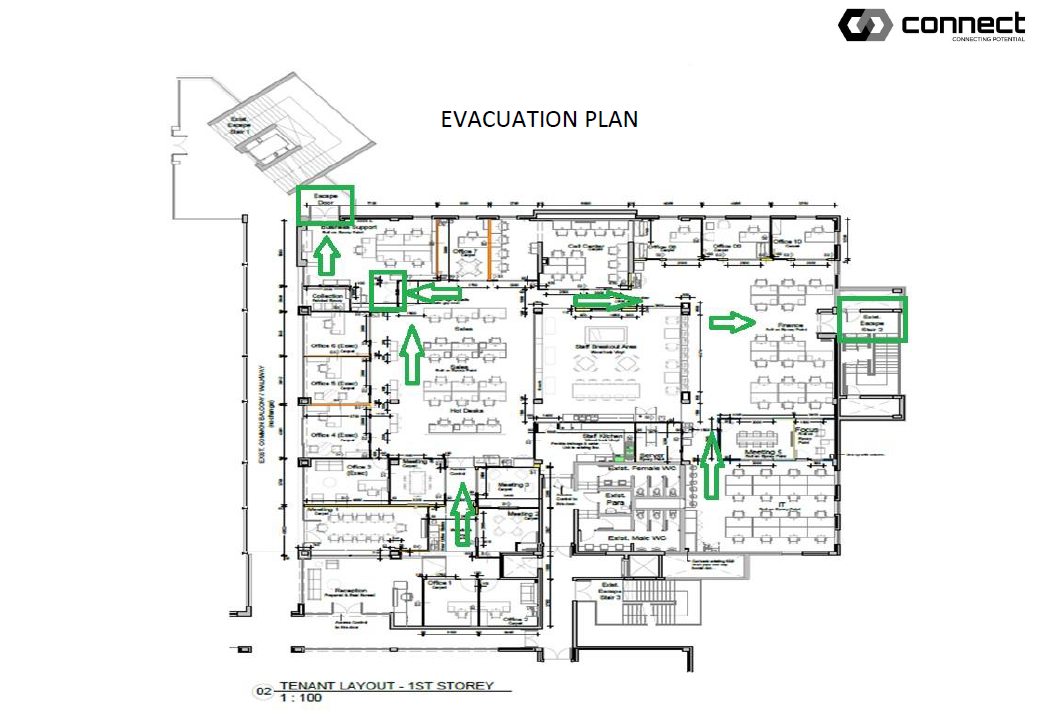
routes are clearly demarcated in accordance with the “Exit Plan” attached
hereto.
14.14.2. The Company shall ensure that there are an adequate supply of fire
extinguishers which are maintained and in good working order at all times and
ensure it is placed in strategic locations as may be recommended by the fire
chief of the local authority concerned.
14.14.3. The “Exit Plan” shall be made available by the Company on the notice boards.
14.14.4. The Company shall ensure that it obtains all necessary compliance
certificates as may be required by applicable laws in relation to fires at the
workplace.
14.15. General Physical Conditions of the Workplace
14.15.1. The Company shall ensure that it obtains all necessary compliance
certificates as may be required by applicable laws in relation to:
14.15.1.1. Thermal requirements (>6℃)
14.15.1.2. Lighting;
14.15.1.3. Windows;
14.15.1.4. Ventilation;
14.15.1.5. Housekeeping;
14.15.1.6. Precautions against flooding;
14.15.1.7. Sanitation;
14.16. Natural Resources Management
14.16.1. The management of natural resources such as land, water, soil, plants, and
animals affect the quality of life for both present and future generations.
14.16.2. The Company will ensure that:
14.16.2.1. the natural resources used in its business activities will be conserved and
used sparingly;
14.16.2.2. the efficient use of natural resources will be optimised. To achieve this, the
consumption of water and electricity will be monitored and reduced where
possible; and
14.16.2.3. the pollution of land, water and air is prevented/minimised.
14.17. Waste Management
14.17.1. The effective management of waste is critical to preventing environmental
pollution during waste generation and disposal and to reducing the quantities
of waste disposed of at landfill sites.
14.17.2. “Waste management” addresses waste management strategies prior to the
disposal of waste. This includes waste separation, waste reduction, waste reuse
and waste recycling.
14.17.3. The National regulatory requirements relating to waste management are
included in the following pieces of legislation:
14.17.3.1. the Environment Conservation Act (No. 73 of 1989);
14.17.3.2. the Water Act (No. 36 of 1998); and
14.17.3.3. the various National Environmental Management Acts and their
amendments.
14.17.3.4. the National Environmental Management Amendment Act (No. 8 of 2004);
14.17.3.5. the National Environmental Management Act: Air Quality Act (No. 39 of
2004); and
14.17.3.6. the National Environmental Management Act: Waste Act (No. 59 of 2008);
14.17.3.7. National Policy on Thermal Treatment of General and Hazardous Waste;
and
14.17.3.8. National Waste Information Regulations (2004).
14.17.4. “Waste” means any substance that:
14.17.4.1. is surplus, unwanted, rejected, discarded, abandoned or disposed of;
14.17.4.2. the generator has no further use of for the purposes of production;
14.17.4.3. must be treated or disposed of; and
14.17.4.4. is identified as a waste by the Minister by notice in the Government
Gazette, and includes waste generated by the mining, medical or other
sector, but excludes:
14.17.4.5. by-products; and
14.17.4.6. any portion of waste once re-used, recycled and recovered.
14.17.5. Waste Policy: The Company is committed to the effective management of
waste. The Company will avoid/minimise the generation of waste to divert
waste from landfill disposal. Where possible, the Company’s waste will be
classified, and separated and the Company will consider reducing, re-using,
and recycling waste prior to disposal.
14.17.6. Waste Reduction: All waste will be considered for reduction. This can be
accomplished by evaluating the efficiency of processes with the aim of
reducing waste generation. Where possible, the volume occupied by the
waste will be reduced (for example, by means of crushing).
14.17.7. Waste Re-Use: All waste materials will be considered for re-use. Any
materials re-used must be suitable, non-toxic, clean and in a good condition.
14.17.8. Waste Recycling: All waste materials will be considered for recycling. Any
materials recycled must be non-toxic, clean and in a good condition.
Examples of materials that are suitable for recycling include metals (ferrous
and non-ferrous types separated), wood, paper, cardboard,
printer/photocopier ink cartridges, plastics and glass.
15. Visitors Procedure
15.1. The Company is aware of the need to protect any person entering the workplace
from hazards and risks. Therefore, the Company will endeavour to ensure a safe
environment for all persons entering its premises.
15.2. Visitor Responsibilities:
15.2.1. All visitors and contractors entering the Company’s premises are to report to
reception upon arrival.
15.2.2. Areas that are off-limits to visitors and contractors include confidential
records, equipment, and computer network.
15.2.3. All visitors and contractors must follow all verbal instructions and signs.
15.2.4. Smoking is prohibited within the premises.
15.3. The following activities are forbidden:
15.3.1. Leaving designated work areas.
15.3.2. Unauthorized operation of any equipment.
15.3.3. Unlawful activities, including stealing; and
15.3.4. The carrying of a weapon or ammunition on the Company’s property.
15.4. All contractors are responsible to:
15.4.1. Provide PPE for their employees, according to the job requirements;
15.4.2. Ensure their employees always wear their PPE;
15.4.3. Provide their own first aid equipment and medical treatment for their
employees;
15.4.4. Immediately report all unsafe conditions/accidents/ incidents to the Company;
15.4.5. Investigate all incidents to ensure that the possibility of recurrence or further
risk is minimised;
15.4.6. Adhere to all of the Company’s rules and procedures;
15.4.7. Ensure their employees do not receive visitors on the Company’s premises;
15.4.8. Visitors and contractors who fail to follow these procedures will have their
visiting privileges revoked and be asked to leave;
15.4.9. The Company will not be held responsible for injuries suffered by visitors and
contractors as a result of violating this procedure; and
15.4.10. Contractors will be required to give an undertaking that they will obey working
practices which are safe both with respect to the employees, the Company
and third parties.
16. Emergency Procedures
16.1. The primary objective of emergency procedures is the safety of all employees.
Protecting the property is important but is a secondary consideration. The following
instructions and guidelines are to be followed in the case of fire or other disasters.
16.2. Procedure in the event of a fire
16.2.1. The dangers which may threaten employees if a fire breaks out and the
possible extent of damage depend upon many local and individual factors. It
is important that prompt and effective action is taken in the event of a fire. If
prompt action is not taken any delay could allow the fire, which is small on
discovery, to grow quickly to major proportions. It is all employee’s interest to
never:
16.2.1.1. create a fire hazard by leaving stores of rubbish in a corridor or
stairway; and
16.2.1.2. to disregard the smell of burning, but to search until discovery of the
cause and action is taken accordingly.
16.2.2. Discovery of a fire
16.2.2.1. If a fire is discovered in the workplace the following actions are to be taken:
a) Activate the fire alarm which will instruct all employees to evacuate
the building. The fire alarm is activated by opening the fire escape
doors by pressing down on the leaver.
b) The main receptionist shall immediately contact the fire brigade.
c) Those employees instructed on the operation of fire extinguishers,
shall, as far is reasonably practicable, collect the fire extinguishers
from the nearest location and if it is safe to do so proceed to fight the
fire. This action is not to be taken by any employee where it may
involve personal danger.
d) If attempts to extinguish the fire are failing or if the fire fighters
consider that to remain will place them in danger, then such
employee must withdraw and evacuate the workplace.
e) All other employees who have not been instructed on the operation
of firefighting appliances should not attempt to use an extinguisher
but immediately evacuate the workplace in accordance with the
below.
16.2.3. Evacuating the premises
16.2.3.1. Evacuation of the building will be indicated by activating the fire
alarm and instruction by email by the receptionist or the alternative
most expeditious form of communication.
16.2.3.2. On hearing the instruction to evacuate the workplace, all employees
must immediately and calmly proceed to the nearest available
escape route according to the “Exit Plan” attached hereto.
16.2.3.3. Do not use the lifts in the event of a fire.
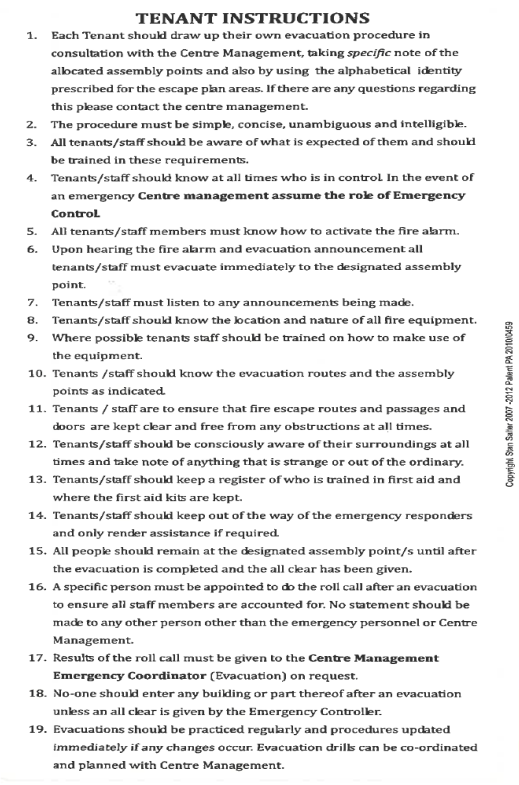
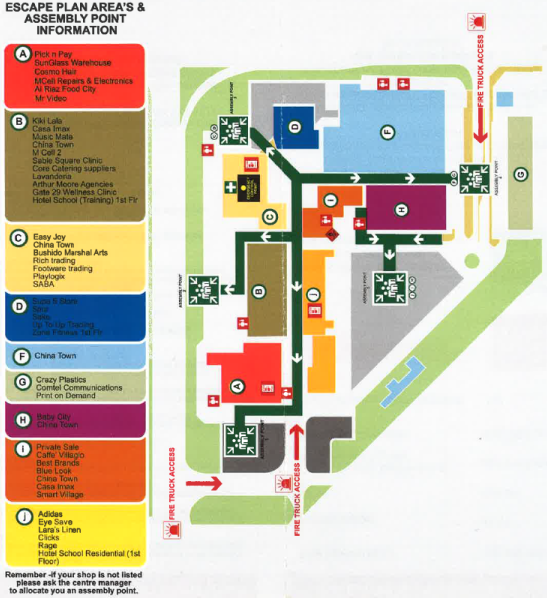
16.2.3.4. Evacuees must assemble quickly at their given assembly points as
recorded in the attached “Building Evacuation”. Visitors and/or
contractors should be taken to the assembly point. The receptionist
shall bring the visitors’ book to the appointed fire marshal.
16.2.3.5. Managers are responsible for ensuring that the employees who
report to them evacuate the premises as swiftly and safely as
possible.
16.2.3.6. On arrival at their assembly point, managers must immediately report
to the Human Recourse Department or fire marshal of the names of
the visitors and/or contractors, and report that all of their employees
are accounted for.
16.2.3.7. No employee, visitors and/or contractor will be allowed to re-enter the
workplace until the fire department authorises re-occupation.
16.2.4. Evacuation assembly points
16.2.4.1. It is the responsibility of each manager, all employees, visitors and/or
contractors to be aware of their evacuation assembly points as
indicated on the attached “Building Evacuation”.
16.2.5. Fire marshals
16.2.5.1. Fire marshals are appointed for each workplace premises.
16.2.5.2. The fire marshals are responsible for directing employees out of the
building and ensuring that all areas are cleared of persons.
16.2.5.3. On no account must a fire marshal re-enter evacuated premises in
an attempt to find any person unaccounted for.
16.2.5.4. Fire marshals must be trained by the Company to operate the fire
extinguishers.
16.2.5.5. Fire marshals, like other employees, should fight a fire once found
only if they feel that they are able to control or put out the fire without
jeopardising themselves or other employees.
16.2.5.6. Employees must ensure that they are aware of who the appointed
fire marshals are. An up-to-date list of fire marshals shall be
displayed on notice boards (including electronic notice boards).
16.2.5.7. Fire marshals, without jeopardising their own safety, will carefully
check that all personnel within their area of responsibility have been
evacuated safely.
16.2.5.8. All employees have the responsibility to respond immediately to the
instructions of the fire marshals.
16.2.5.9. The fire marshals shall collect reports from the managers that all of
their employees are accounted for, including visitors and/or
contractors during an evacuation. Any persons not accounted for
must be reported to Human Resources Department.
16.2.5.10. The fire marshals shall be responsible for communications with the
fire brigade whilst on site.
Cape Town Office Evacuation plan for Sable Square
Was this article helpful?
That’s Great!
Thank you for your feedback
Sorry! We couldn't be helpful
Thank you for your feedback
Feedback sent
We appreciate your effort and will try to fix the article